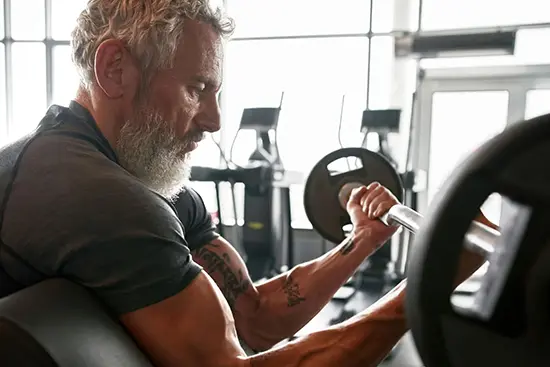
Most workout plans aimed at men over 50 are intimidating. Four-day gym splits, barbell squats, cable machines — great if you're already training, but not where most people actually are. If you're starting from scratch, or getting back into it after years away, this is the guide for you. No gym needed. No equipment needed to begin. Just a clear starting point.
Where to Begin — The Only Rule That Matters
The mistake most men make when returning to exercise after 50 is trying to jump straight into an advanced programme. The result is sore joints, a nagging injury, and giving up within three weeks. The smarter approach is to spend the first month or two building the habit, learning the movements properly, and letting your joints, tendons and ligaments catch up with your enthusiasm.
You don't need equipment to start. You don't need a gym. You need to move — consistently, a few times a week — and build from there. This guide gives you two options depending on where you are right now: a no-equipment bodyweight workout you can do today, and a dumbbell routine to progress to when you're ready.
"The goal at the start isn't to train hard. It's to train consistently — and to still be training in six months."

Option 1: No Equipment — Start Today
So you're close to 50, or you've already passed it. Maybe you haven't trained properly in years — or ever. The question everyone asks at this point is the same: where do I start?
The answer is: start small, and build slowly. For some people that means beginning with a 20-minute walk and taking an honest look at what they're eating. That's not a cop-out — it's the right call. Starting an exercise programme while still eating poorly will limit your results significantly. You don't have the metabolism you had at 25. Nutrition matters more after 50, not less. If the diet isn't roughly right, no amount of exercise will fully compensate for it.
Once you've got that foundation in place — or if you're already reasonably active and just want to move more — the exercises below are a solid starting point. No equipment, no gym, no barrier to entry. If your dumbbells are on order and you want to get started today, this works perfectly as a bridge.
Start With a Walk
Before anything else, walk. Twenty to thirty minutes at a brisk pace — not a stroll, but a pace where you're breathing a little harder than normal. Do this daily if you can. It costs nothing, it's easy on the joints, and it starts building the habit of showing up consistently. Increase the pace or duration gradually as it starts to feel comfortable.
Four Bodyweight Exercises to Begin With
Squats — Stand with feet shoulder-width apart, bend your knees and lower your hips as if sitting back into a chair. Drive through your heels to stand back up. This works your quads, glutes and lower back. Start with whatever number feels manageable — even 5 or 10 is a start — and build from there.
Push-Ups — Keep your body in a straight line and bend your elbows to lower your chest toward the floor. If a full push-up isn't there yet, start against a wall. Seriously — wall push-ups are underrated. They build the habit and the movement pattern without putting any pressure on the wrists or shoulders. Progress to your knees, then to the floor when you're ready.
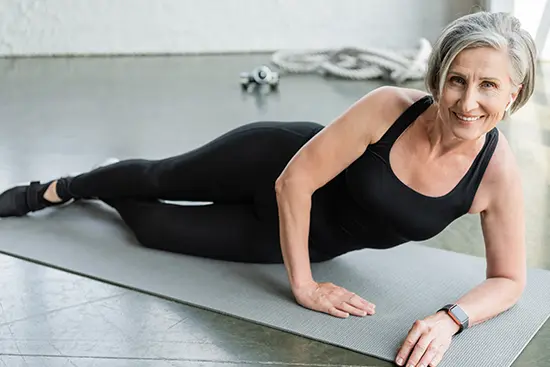
Planks — Hold a straight-arm or forearm position with your body in a straight line. Start at 20–30 seconds and increase the duration as it gets easier. This builds deep core stability, which underpins everything else you'll do.
Lunges — Step forward or backward, lowering your rear knee toward the floor, then push back to standing. Alternating legs, do as many as feel comfortable. These strengthen each leg individually and improve balance — both things that matter more as you get older.
None of these require equipment. All of them translate directly into the dumbbell work when you're ready to progress.
Option 2: Beginner Dumbbell Workout for Over 50s
This is one of the best beginner dumbbell videos available specifically for the over 50s — focused on the right exercises, the right technique, and a pace that doesn't leave you flattened on the floor after five minutes. Watch it through once, then use the exercise table below as a reference while you train.
Watch through the video first to get a feel for each movement before you start. Both videos below use a similar structure — short work intervals followed by a brief rest — so you can follow along without needing to memorise anything.
Want to Follow Along? Try This with Joe Wicks
If you'd rather follow a guided workout than train from a table, this 15-minute session from Joe Wicks — The Body Coach — covers the same foundational dumbbell movements with a focus on technique and controlled tempo. It's one of the best follow-along beginner workouts available and a great way to run through the exercises the first few times until they become second nature.
What You Need to Get Started
Two things: a pair of dumbbells and an exercise mat. That's the entire equipment list for this routine.
Recommended Starting Kit
Dumbbells — For most men starting out, a set in the 5–8 kg range is the right entry point. Adjustable sets are worth considering if you want to progress without buying multiple pairs.
Browse adjustable dumbbell sets on Amazon →
Exercise mat — You'll need one for the floor press (exercise 9). A simple 10mm foam mat is fine — nothing fancy required.
Browse exercise mats on Amazon →
As an Amazon Associate we earn from qualifying purchases. This doesn't affect the price you pay.
On weight selection: choose a weight where you can complete 40 seconds of controlled reps with good form, but feel genuine effort in the last 10 seconds. If you're breezing through to the end with nothing left in the tank, go heavier. If your form is breaking down halfway through, go lighter. 6 kg is a reasonable starting point for most men — though some exercises like goblet squats and RDLs will allow heavier than others like lateral raises and front raises.
How Often to Do This
Two to three times per week is the target for the first four to six weeks. Monday, Wednesday, Friday works well — it gives you a full day of recovery between sessions, which matters more after 50 than it did in your 30s. The adaptation — muscle growth, improved strength — happens during recovery, not during the session itself. Rest is part of the training.
Don't be tempted to do this every day. Your joints and tendons take longer to adapt than your cardiovascular system, and the most common beginner mistake at any age is doing too much too soon. Two solid sessions per week, consistently, will produce better results than five rushed ones with a sore shoulder by week three.
When You're Ready to Progress
After four to six weeks of this routine — done consistently, two to three times per week — you'll notice it starting to feel more manageable. That's the signal to progress. You have a few options:
- Increase the weight. The simplest and most effective step. Even moving from 6 kg to 8 kg changes the workout significantly.
- Do two rounds. Run through the workout twice with a two-minute rest between rounds. Takes around 30–40 minutes and substantially increases the training volume.
- Move to a structured programme. Once you're comfortable with dumbbell movements and have a few months of consistency behind you, a more structured weight training programme is the natural next step.
The goal for the first few months is simple: build the habit. Turn up, do the work, recover, repeat. The results follow from that — not from the perfect programme.
Frequently Asked Questions
Yes — dumbbells are one of the most effective tools for building muscle at any age, and particularly well-suited to men over 50 because they allow natural joint movement and can be used at home without a gym membership. Progressive overload still applies: as you get stronger, you increase the weight.
A weight where you can complete 40 seconds of controlled reps with good form, but feel genuine effort in the last 10 seconds. For most men starting out that is somewhere between 4 kg and 8 kg. The goal at the beginning is technique and consistency — you can increase the weight when the current weight no longer challenges you.
Two to three times per week is ideal for beginners. This gives the muscles time to recover between sessions, which is especially important after 50. Rest and recovery are where the adaptation actually happens — training more often is not always better.
For the floor press exercise (lying on your back) a mat makes a real difference to comfort. It also helps with grip during floor-based movements. A basic exercise mat is a worthwhile investment alongside your dumbbells.
Unlimited Fitness Ireland
Ireland's fitness resource for the over 50s. We cover strength training, martial arts, motivation and nutrition — because your best training years might still be ahead of you. Age is not a factor.
Related Articles
Sources & Further Reading
Bhasin, S., et al. (2001). Testosterone Dose-Response Relationships in Healthy Young Men. American Journal of Physiology. View on PubMed ↗
Walker, S., et al. (2017). Neuromuscular Fatigue and Recovery After Heavy Resistance Exercise in Older Men. European Journal of Applied Physiology. View on PubMed ↗
Fiatarone, M.A., et al. (1990). High-Intensity Strength Training in Nonagenarians. JAMA. View on PubMed ↗