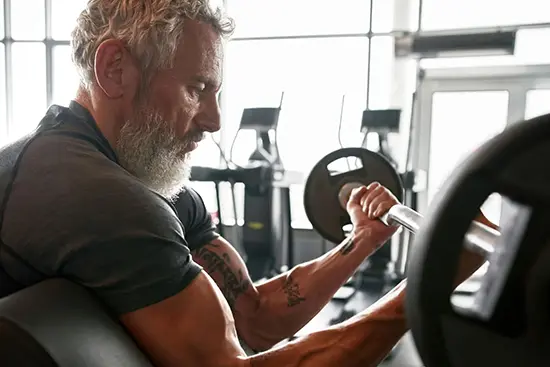
Wanting to look good is not a shallow goal. It is, if anything, one of the more honest and sustainable motivations in fitness — because how you look is a direct reflection of how you're living. A strong, lean physique after 50 is visible evidence of the training you're doing, the food choices you're making, and the consistency you're bringing to both. This guide is about how to build one.
Let's Address the "At Your Age" Attitude
There's a cultural assumption that caring about your physique after 50 is somehow inappropriate — that you should be grateful for whatever shape you're in and stop being concerned with how you look. It's nonsense, and it's worth dismissing it plainly before we go any further.
The people who look best at 55, 60 and 65 don't look that way by accident. They train. They eat well. They've made their physical health a priority, and the result shows. That's not vanity — it's evidence of a lifestyle that also happens to produce better energy, better health markers, lower disease risk and a better quality of life. Looking good and being healthy are, to a very large extent, the same project.
If wanting to look good on a beach or feel genuinely confident without a shirt on is your motivation — good. Use it. It's a more durable motivator than abstract health goals, and it will keep you showing up when abstract goals wouldn't.
What a Strong Physique Over 50 Actually Requires
The formula is not complicated, but it requires all parts to be working simultaneously. Training without nutrition produces limited results. Nutrition without training produces weight loss but not the muscle definition that makes a physique look good. Both without consistency produces nothing.
Build Muscle — It's the Foundation of Everything
A lean, defined physique is built on muscle. Not the bulk of a bodybuilder — the functional, visible muscle that fills out a frame, creates definition in the arms and shoulders, produces a flat or defined midsection, and gives the body the shape that distinguishes someone who trains from someone who doesn't.
Muscle does not appear through cardio. It is built through progressive resistance training — compound lifts performed consistently over months and years with progressively increasing load. The four-day workout routine or the women's training plan provide the structure. The key variables are consistency and progressive overload — the weight needs to increase over time, or the body has no reason to grow.

Reduce Body Fat — Reveal What You're Building
Muscle definition is visible when body fat is low enough. You can have a well-developed set of abdominals underneath a layer of fat and see none of it. Fat loss is primarily a nutrition task — as we covered in detail in the belly fat article — but the training contributes significantly through the metabolic effect of compound strength work and interval sessions.
The goal is not to be as lean as possible. It's to reduce body fat to a level where the muscle you're building becomes visible. For most people that means getting out of the range where visceral fat dominates the midsection and into a range where the shoulders, arms and midsection have visible shape. That's achievable for most people within six to twelve months of consistent training and sensible nutrition.
Posture — The Underrated Visual Factor
Good posture adds more to how a physique looks than almost any specific muscle group. Shoulders pulled back, chest open, spine upright — this alone changes how a body presents, regardless of where training is. And posture is directly trainable. The muscles that support good posture — the upper back, rear deltoids, deep spinal extensors and core — are built through exactly the compound pulling movements that should be in every programme: rows, face pulls, lat pulldowns, deadlifts. Training the back as hard as the chest is not just aesthetic advice — it is structural.
The Timeline — What to Expect and When
Honest expectations matter here, because the gap between expectation and reality is where most people quit.
In the first four to six weeks, visible changes in the mirror will be modest. What you'll notice is strength — lifts getting heavier, movements getting cleaner, energy improving. This is real progress, even if it doesn't look like it yet. The neuromuscular adaptations of the first weeks are building the foundation for everything that follows.
By weeks eight to twelve, body composition changes become visible for most people. Arms and shoulders begin to show more definition. The midsection starts to flatten if nutrition is supporting the training. Clothes fit differently. People who haven't seen you for a while notice.
The physique you're genuinely proud of — the one you'd be happy to take to a beach — is a twelve to twenty-four month project for most people starting from a baseline of limited training. That is not a long time. It is significantly less time than most people spend wishing they looked different without doing anything about it.
"The best physique you've ever had might still be ahead of you. That's not motivational copy — it's what consistent training after 50 actually produces for people who commit to it."
The Nutrition That Makes It Work
Two priorities above all others: adequate protein to support muscle growth and repair, and controlled carbohydrates to manage body fat. Protein at every meal — 1.6 to 2.2 grams per kilogram of bodyweight per day. Refined carbohydrates reduced and replaced with vegetables, whole foods and higher-fibre sources that don't spike blood sugar and keep insulin elevated. The constant snacking that keeps the body in fat-storage mode eliminated. Three solid meals, protein-anchored, spaced far enough apart to allow insulin to drop and fat burning to occur.
Hydration matters more than most people account for. Adequate water intake supports every metabolic process involved in both fat loss and muscle building, and mild dehydration noticeably impairs training performance.
Consistency Is the Only Variable That Can't Be Substituted
The programme doesn't need to be perfect. The nutrition doesn't need to be flawless. What it needs to be is consistent — training three to four times per week, every week, for months and years rather than weeks. The people who build the best physiques after 50 are almost never the people with the most sophisticated programmes. They are the people who show up, do the work, and keep doing it when motivation ebbs.
If you're ready to start, the beginner's weight training guide is the right first step. If you've been training for a while and want to take it further, the men's four-day programme or women's training plan give you the structure to do that.
Frequently Asked Questions
Yes — and for many people, the physique they build after 50 with deliberate training is better than anything they had in their 30s. The combination of progressive strength training, controlled nutrition and adequate recovery produces real, visible changes in body composition at any age. It takes longer than it did at 25, but the results are absolutely achievable.
Most people notice meaningful improvements in strength and energy within four to six weeks. Visible changes in body composition appear after eight to twelve weeks of consistent training and supportive nutrition. A genuinely transformed physique is a twelve to twenty-four month project, built through consistency rather than short bursts of effort.
No. Wanting to look good is a legitimate motivation, and a durable one. A strong, lean physique is also a direct indicator of the training and lifestyle choices that support long-term health — more muscle, less visceral fat, better metabolic function. Looking good and being healthy are the same project.
Unlimited Fitness Ireland
Ireland's fitness resource for the over 50s. We cover strength training, martial arts, motivation and nutrition — because your best training years might still be ahead of you. Age is not a factor.