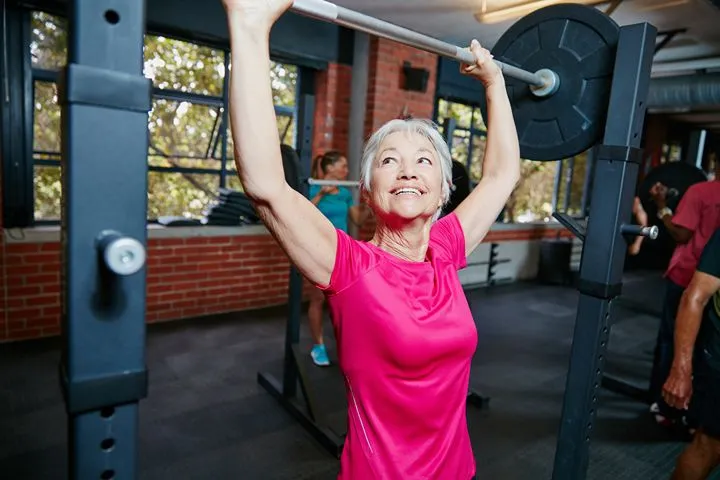
If you're a man over 50 thinking about starting weight training — or getting back to it after years away — here's the most important thing to know: you're not too late, and the testosterone drop and muscle loss that come with age are not irreversible. Your body is significantly more capable of adapting than you've probably been told. This guide covers everything you need to start, from the very first session if you haven't trained in years, right through to building a routine that produces real results.
Why Weight Training Is Especially Important After 50
After the age of 30, the body naturally begins to lose muscle mass — a process called sarcopenia. By your 50s, without deliberate effort to reverse it, you can be losing up to 1–2% of your muscle mass every year. The consequences compound over time: reduced strength, slower metabolism, more body fat, poorer balance, and less capacity to do the things you enjoy.
The research on this is compelling. A landmark study published in the Journal of Cachexia, Sarcopenia and Muscle found that low muscle mass in older adults is strongly associated with increased mortality risk — independent of other health factors. Separately, research from the American Journal of Epidemiology has linked greater muscle strength with significantly lower all-cause mortality in middle-aged and older adults. In plain terms: maintaining and building muscle after 50 is not about vanity. It is one of the most meaningful things you can do for how long and how well you live.
Weight training is the single most effective intervention to counter sarcopenia. For men specifically, lifting weights also helps counteract the effects of declining testosterone — which accelerates after 40 and contributes directly to the muscle loss, belly fat accumulation and reduced energy that many men in their 50s attribute simply to "getting older". It stimulates muscle protein synthesis, improves bone density, boosts metabolism, and improves insulin sensitivity. Cardio has its place — but if you're only doing one thing after 50, lift weights.

Do You Need a Doctor's Clearance Before Weight Training Over 50?
If you haven't been active for a long time, or if you have any existing health conditions — heart issues, high blood pressure, joint problems, diabetes — it's worth a quick conversation with your GP before you begin. This isn't a legal disclaimer or an attempt to put you off. It's practical. Your doctor can flag anything that needs to be worked around, and in most cases they'll actively encourage you to start. Going in with a clean bill of health, or at least a clear picture of what to be mindful of, means you can train with confidence rather than caution.
If You Haven't Trained in a Long Time — Start Here
The biggest mistake people make returning to exercise after a long break is doing too much too soon. The motivation is there, the intention is good, but the body hasn't been asked to do this for years and it needs time to adapt. The result is usually soreness that kills enthusiasm, or worse, an injury in week one that sets everything back.
The smarter approach is to start smaller than feels necessary and build from there. For the first two weeks, light dumbbells — 2 to 4 kg — are enough. The goal is not to push hard. The goal is to teach your joints, tendons and muscles to move under load again, to wake up the neuromuscular connections that haven't been used in a while, and to establish the habit of training before you add any real intensity to it.
Two exercises are particularly useful at this stage, and you can do both at home with no equipment at all.
Wall Press-Ups
A wall press-up is simply a press-up performed standing, with your hands flat against a wall rather than on the floor. You lean in at an angle, lower your chest toward the wall by bending your elbows, then push back. It looks straightforward — and it is — but it does exactly what you need it to do when you're starting out: it activates the chest, shoulders and triceps, gets those muscles working together again, and does so with a fraction of the load of a floor press-up. There is no risk of collapsing under your own bodyweight, and the range of motion is easy to control.
Start with two sets of ten. Once that feels easy, move your feet slightly further from the wall to increase the angle and the challenge. When that becomes comfortable, progress to an incline press-up using a sturdy table or bench, and eventually to a full floor press-up. The progression is logical and the strength carries directly into dumbbell pressing movements.
Planks
The plank is one of the best core exercises available at any age, and it requires nothing except a floor. Hold a straight line from your head to your heels — either on your forearms or hands — and resist the urge to let your hips sag or rise. Everything stays tight.
If you haven't trained in a long time, start at 20 to 30 seconds and treat that as your target for the first week. That is not a short time when you're doing it correctly with full tension. Build to 45 seconds, then 60, over the following weeks. Three sets with a 60-second rest between them is a solid plank session.
Together, wall press-ups and planks are a genuinely effective way to begin activating the chest, shoulders, arms and core before you introduce any weighted exercises. They also give you an early sense of progress — when you can feel yourself getting stronger week by week at something simple, it sets the tone for everything that follows.
"Start smaller than feels necessary. The goal in week one is to build the habit, not to prove a point. The weight will come."
How Often Should You Train?
Two to three sessions per week is the right starting point. This gives your muscles enough stimulus to grow and adapt while allowing sufficient recovery time between sessions. Recovery takes longer after 50 than it did in your 20s — that's not a weakness, it's physiology. Work with it, not against it.
A full-body routine three times a week — Monday, Wednesday, Friday, for example — works well for most beginners. As you progress, you might split into upper/lower body sessions or push/pull routines, but there's no need to complicate it at the start. Three solid full-body sessions will produce results for the first six to twelve months.
Moving to Dumbbells — The Core Exercises
Once the wall press-ups and planks feel routine — typically after two to three weeks — it's time to introduce light dumbbells and build toward the compound movements that will form the backbone of your training. Compound exercises work multiple muscle groups at once. They are more time-efficient, more functional, and produce better overall results than single-muscle isolation work.
Start with weights that feel almost too easy. The first two weeks with dumbbells are still about movement pattern, not load. Here's what to build toward:
| Exercise | Muscles Worked | Beginner Notes |
|---|---|---|
| Goblet squat | Quads, glutes, core | Hold dumbbell at chest height; easier to maintain posture than a barbell squat |
| Romanian deadlift | Hamstrings, glutes, lower back | Builds posterior chain; directly reduces lower back pain with consistent practice |
| Dumbbell press | Chest, shoulders, triceps | Flat or incline; more joint-friendly than a barbell for beginners |
| Dumbbell row | Upper back, biceps | Critical for posture; seated or bent-over both work well |
| Overhead press | Shoulders, upper body | Start very light — shoulder mobility often needs time to open up after inactivity |
| Plank | Core, lower back | Build from 30 seconds; a strong core underpins every other lift |
How Heavy Should You Lift?
Start lighter than you think you need to. The first two to four weeks are about learning movement patterns, not pushing load. Poor technique under heavy weight is the fastest route to an injury that sets you back months.
A useful rule of thumb: choose a weight where you can complete your target reps with good form, and where the last two reps feel genuinely challenging. If you finish a set of ten and feel like you could easily do ten more, it's too light. If your form breaks down by rep seven, it's too heavy. For most beginners, three sets of eight to twelve reps per exercise is a good target range. As you get stronger — and you will — increase the weight in small increments. Even 1–2 kg jumps are meaningful progress.
What About Joints and Injuries?
This is the concern most people over 50 lead with. The honest answer is that weight training, done correctly, protects joints rather than damaging them. Strengthening the muscles around a joint increases its stability and reduces the load placed on the joint itself. Many people find that chronic knee or lower back pain improves significantly after a few months of structured strength training.
If you have a specific existing injury — a torn meniscus, a shoulder impingement, significant arthritis — it's worth getting advice from a physio before loading that area heavily. The goal is to train around limitations intelligently, not to ignore them or to be stopped by them.
Want to know what to eat to support your training? Read our guide on nutrition and recovery for over 50s.
Nutrition for Over 50sHome Training vs the Gym
You don't need a gym membership to get started. A set of adjustable dumbbells (a €50–€100 investment) and a resistance band set will cover the majority of movements in this guide. Many people make excellent progress training at home, particularly in the early months. And as described above, the very first steps — wall press-ups and planks — require nothing at all.
The case for the gym is access to heavier weights as you progress, cable machines, a barbell and squat rack, and the motivating effect of training around other people. Most gyms in Ireland are welcoming environments — the days of the intimidating gym floor are largely gone. If the budget is there and you're someone who benefits from an external environment, a gym is worth the monthly cost.
A Simple Starting Routine
Three days a week, full body, at least one rest day between sessions. For the first two weeks, replace the dumbbell press with wall press-ups and keep weights very light across the board. Build to the below over weeks three and four.
| Exercise | Sets | Reps / Duration |
|---|---|---|
| Goblet squat | 3 | 10 reps |
| Romanian deadlift | 3 | 10 reps |
| Dumbbell press (flat or incline) | 3 | 10 reps |
| Seated dumbbell row | 3 | 10 reps each arm |
| Dumbbell overhead press | 3 | 10 reps |
| Plank | 3 | 30–60 seconds |
Six exercises, three times a week. It doesn't look dramatic on paper — but executed consistently over three to four months, it produces a meaningful improvement in strength, body composition and how you feel day to day. That's the foundation. Everything else builds from here.
Once this becomes your normal, have a look at where to take it next: a structured weekly routine for men over 50 or the best workouts for women over 50 go deeper on programming once the basics are established.
Frequently Asked Questions
Yes — weight training is not only safe for most adults over 50, it's one of the most beneficial things you can do for your health. The key is starting with appropriate weights, focusing on technique before load, and progressing gradually. If you have existing health conditions, a quick check with your GP before starting is sensible, but for most people there is no barrier to beginning.
Two to three days per week is the ideal starting point for beginners over 50. This gives your body enough stimulus to adapt and build strength while allowing adequate recovery time between sessions. As you progress and your body adapts, you can increase to three or four days per week if you choose.
Both are effective. Machines are a good starting point because they guide your movement pattern and reduce injury risk while you learn. Free weights — dumbbells and barbells — develop more stabilising muscle and better functional strength, but require more technique. A combination of both is ideal for most beginners.
Most people notice improved strength and energy within four to six weeks. Visible changes in body composition typically appear after eight to twelve weeks of consistent training. Muscle building is slower after 50 than in younger years, but it absolutely happens — and the strength and metabolic benefits begin much sooner than the mirror will show.
No. A basic home setup with a set of adjustable dumbbells and some resistance bands is enough to get started and make solid progress. That said, a gym gives you access to more equipment, heavier weights as you progress, and the social environment that many people find motivating. Both approaches work well.
Unlimited Fitness Ireland
Ireland's fitness resource for the over 50s. We cover strength training, martial arts, motivation and nutrition — because your best training years might still be ahead of you. Age is not a factor.
Related Articles
Sources & Further Reading
Cruz-Jentoft, A.J., et al. (2019). Sarcopenia: Revised European Consensus on Definition and Diagnosis. Age and Ageing / Oxford Academic. View on Oxford Academic ↗
Ruiz, J.R., et al. (2008). Association Between Muscular Strength and Mortality in Men: Prospective Cohort Study. British Medical Journal. View on BMJ ↗
Chodzko-Zajko, W.J., et al. (2009). Exercise and Physical Activity for Older Adults — ACSM Position Stand. Medicine & Science in Sports & Exercise. View on PubMed ↗
Layne, J.E., & Nelson, M.E. (1999). The Effects of Progressive Resistance Training on Bone Density: A Review. Medicine & Science in Sports & Exercise. View on PubMed ↗