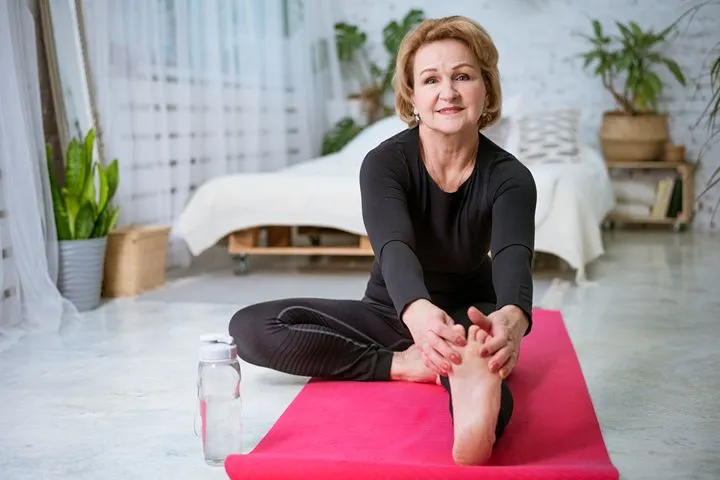
If yoga has been on your mind but you've been putting it off — too stiff, too unfit, too late to start — this article is for you. Because the thing stopping most people from walking into their first yoga class isn't lack of interest. It's a set of assumptions about what yoga is and who it's for. Almost all of them are wrong.
Why Yoga Makes So Much Sense After 50
There's a reason yoga keeps appearing in every conversation about fitness for this age group. It isn't a trend — the evidence behind it is substantial and specific to the changes your body goes through after 50. Flexibility declines. Joint mobility narrows. The muscles that stabilise the spine and hips weaken. Balance deteriorates. Sleep becomes lighter. Stress accumulates in the body in ways that are harder to shake. Yoga addresses all of this in a single practice.
A systematic review published in the British Journal of Sports Medicine found that yoga produced meaningful improvements in physical function, balance, flexibility and mental wellbeing in older adults — making it one of the most broadly effective forms of exercise available for this age group. These aren't marginal gains. People who start yoga after 50 and stick with it consistently report that it changes how they move, how they sleep and how they feel about their own physical capability.
What makes yoga particularly well-suited to life after 50 is that it scales. A 30-year-old can power through an intense Vinyasa class that would be entirely inappropriate for someone returning to exercise after years away. Yoga offers versions of itself that are genuinely accessible from day one — and that still challenge you and deliver results. You don't have to earn your way in.
You Don't Need to Be Flexible — That's the Point
Let's deal with the most common obstacle immediately. The assumption that you need to be flexible before starting yoga is the single biggest reason people who would benefit most from it never try it. It gets the logic completely backwards. Flexibility is what yoga gives you — not what you need to bring.
Every yoga pose has modifications and variations. A forward fold that one person reaches their hands flat to the floor in might be done with bent knees and hands to shins for someone else. A balancing pose that looks effortless for an experienced practitioner might be done with a hand on the wall for a beginner. None of these modifications make the practice less effective. They make it appropriate. And a good instructor will offer options as a matter of course, not as an afterthought for people who are struggling.
The honest reality of a beginner yoga class is that the majority of people in it are nowhere near what flexibility looks like on social media. They're regular adults who move the way regular adults move. Nobody is watching you. The instructor is watching to make sure you're doing things safely, not to compare you to anyone else.
"Yoga doesn't ask you to be flexible. It asks you to show up. The flexibility follows — usually sooner than you'd expect."
What Yoga Actually Does for Your Body After 50
It's worth being specific here, because yoga's benefits in this age group are not vague or speculative. They're well-documented and directly relevant to the physical realities of being in your 50s, 60s or beyond.
Flexibility and Mobility
The most obvious benefit — and the one most people come for initially. Regular yoga practice lengthens muscles, improves range of motion across major joints, and reduces the chronic tightness that builds in the hips, hamstrings, lower back and shoulders over years of sitting, driving and desk work. Even two or three sessions a week will produce noticeable improvements within a month.
Balance and Fall Prevention
Falls are a significant health risk for adults over 60 in Ireland, and deteriorating balance is one of the primary reasons. Yoga places substantial demands on the balance systems — the proprioceptive networks, the core stabilisers, the ankle and knee stabilising muscles — in ways that translate directly to safer movement in everyday life. Research from the University of Sydney found that yoga practice significantly reduced fear of falling and improved balance measures in adults over 60. That's not a small thing. It's the difference between a life where you move freely and one where you start to restrict what you do because you don't trust your body.
Core Strength and Spinal Health
Almost every yoga pose requires active engagement of the core — the deep muscles of the abdomen, lower back and pelvis that support the spine. Unlike the superficial muscles trained by crunches, yoga targets the muscles that actually protect the lower back in functional movement. Lower back pain is one of the most common complaints among adults over 50 in Ireland, and a consistent yoga practice is one of the most effective non-pharmacological approaches to managing and reducing it.
If you're already following a weight training programme, the spinal stability and mobility that yoga develops is a direct complement to that work — and will likely improve your lifting form and reduce injury risk.
Joint Health
Synovial fluid — the substance that lubricates your joints — is distributed through movement. When joints are underused, they stiffen and become painful. Yoga moves every major joint through its full range of motion in a controlled, low-impact way, keeping joints healthy and reducing the inflammation associated with conditions like osteoarthritis. Many people find that their joint pain decreases significantly with regular yoga, even when other forms of exercise have aggravated it.
Bone Density
After 50, bone density declines — particularly in post-menopausal women, for whom osteoporosis is a significant concern. The weight-bearing nature of many yoga poses places gentle stress on bones, which stimulates bone-forming cells and helps slow this decline. Combined with the strength training covered in our workouts for women over 50, yoga provides a powerful combined approach to bone health.
Breathing and Nervous System
Every yoga practice involves deliberate breathwork — deep, controlled breathing that activates the parasympathetic nervous system and reduces the physiological effects of chronic stress. For adults carrying the accumulated pressures of work, family and life, this isn't a minor benefit. Yoga's breathing practices (pranayama) have been shown to reduce cortisol levels, lower blood pressure and improve sleep quality — all of which have downstream benefits for physical health and recovery.
Mental Health and Cognitive Function
Research published in Brain Plasticity found that regular yoga practice was associated with increased grey matter volume in regions of the brain associated with attention, memory and emotional regulation. For adults over 50, this is meaningful — yoga doesn't just make you feel calmer in the short term. The structural changes in the brain suggest long-term cognitive benefits comparable to those seen with other forms of exercise, but with the additional element of focused attention and mindfulness that yoga specifically demands.
If motivation and mental resilience are something you're working on, the article on finding your motivation after 50 covers the mental side of getting started in more depth.
Choosing the Right Type of Yoga
Yoga is not one thing. The word covers a wide range of styles, intensities and approaches — some of which are extremely well-suited to adults over 50, and some of which are better approached once you have a foundation. Here's a practical breakdown.
Hatha Yoga
The best starting point for almost everyone. Hatha classes move slowly and deliberately, holding each pose for several breaths with a focus on correct alignment. You'll learn the foundational poses that appear in every other style of yoga, and you'll learn them properly. Most beginner yoga classes in Ireland are Hatha-based, whether or not they're explicitly labelled as such. If you're looking for your first class, start here.
Yin Yoga
Yin is a slower, more meditative practice in which poses are held for three to five minutes at a time, targeting the deep connective tissue — fascia, ligaments, joint capsules — that other forms of exercise don't reach. It's not easy in the conventional sense — holding a hip opener for four minutes demands a particular kind of mental patience — but it's accessible regardless of fitness level and produces remarkable results for mobility and joint health. Many Irish practitioners over 50 find Yin yoga becomes their favourite practice precisely because it addresses the specific restrictions they've accumulated over decades.
Restorative Yoga
Deeply passive and deeply restful — props (bolsters, blankets, blocks) support the body in poses that require no muscular effort. The focus is entirely on relaxation and nervous system recovery. Not a primary fitness practice but an excellent complement to more active training, and invaluable for periods of stress, fatigue or recovery from illness or injury.
Chair Yoga
All the principles and benefits of yoga, adapted to be done seated in a chair or using a chair for support. Available at many community centres and leisure facilities across Ireland, and ideal for anyone with significant mobility limitations, balance concerns, or conditions that make floor-based practice impractical. Don't dismiss it as a lesser option — the physical and mental benefits are identical; only the vehicle changes.
Vinyasa / Flow Yoga
More dynamic and physically demanding — poses are linked together in flowing sequences synchronised to the breath. Better approached once you have a foundation in the basic poses. If you're already reasonably fit and active, a beginner Vinyasa class may suit you from the start; if you're returning to exercise after a long break, build your base in Hatha first.
Finding Yoga Classes in Ireland
The yoga scene in Ireland has expanded significantly over the past decade. Whether you're in Dublin, Cork, Galway, Limerick or a rural town, there are more options than ever — studios, community centres, GP referral programmes, and online classes.
The best place to start is Yoga Ireland, the national representative body for yoga teachers and studios. Their website maintains a searchable directory of registered teachers and studios across the country, with style and level information for each listing. Registered teachers have completed accredited training and hold appropriate insurance — a meaningful quality marker in a field where regulation is otherwise limited.
For a first class, look specifically for sessions described as beginner-friendly, gentle, over-50s, or suitable for all levels. Many studios run dedicated introductory courses over four to six weeks — these are worth seeking out, as they move at a slower pace, cover the foundational poses in more depth, and give you more individual attention than a standard drop-in class.
Community centres and leisure centres across Ireland increasingly offer yoga as part of their adult fitness programming, often at a lower cost than specialist studios. If budget is a factor, these are worth checking — the teaching quality in community settings is frequently excellent, and the atmosphere tends to be unpretentious and welcoming for people who are genuinely new to it.
Google reviews are your friend here. Read what other beginners have said about how they were welcomed, how the instructor treated newcomers, and whether the class felt inclusive. A few minutes of this research will tell you more than a studio's own website ever can.
Looking for other ways to support your movement and wellbeing? Our nutrition guide covers the dietary side of keeping your body performing well after 50.
Nutrition & Recovery Over 50What to Expect in Your First Class
Knowing what happens removes the last barrier to going. Here's how a typical beginner yoga class in Ireland runs.
Arrive a few minutes early. Tell the instructor it's your first class — they'll appreciate it, and it means they'll keep an eye on you during the session. Wear comfortable, stretchy clothing you can move freely in. You'll practise in bare feet. Yoga mats are provided by most studios; if you're going regularly, buying your own is a modest investment that pays back in comfort and hygiene.
The class will open with a few minutes of stillness — settling, breathing, arriving in the room after whatever the day has thrown at you. This is not wasted time. It's part of the practice. Then a gentle warm-up, moving slowly through the spine, the hips and the shoulders to prepare the body for deeper movement.
The main practice will move through a sequence of poses, held for several breaths each. The instructor will demonstrate, cue verbally, and offer modifications throughout. You'll be doing things at your own pace and in your own version of each pose — this is completely normal and expected. Nobody in the room is watching you.
The class finishes with Savasana — the final relaxation, lying flat on your back for five to ten minutes while the nervous system integrates everything the practice has done. Don't skip this part. It's not an optional cool-down. It's where a significant proportion of the physical and psychological benefit is consolidated. You'll leave feeling different to how you walked in. Most people leave wondering why they waited so long.
Frequently Asked Questions
No — and this is worth saying clearly. Yoga is one of the few forms of exercise that genuinely suits this stage of life. Many people across Ireland begin yoga in their 50s, 60s and 70s and find it fits better than it would have at any earlier point. You don't need to be flexible, fit, or experienced. You just need to show up.
For most beginners over 50, Hatha yoga is the best starting point — slower-paced, focused on alignment, and accessible regardless of your current fitness level. Yin yoga is excellent for deep mobility work and joint health. Chair yoga is a great option if you have balance or mobility concerns. Speak to the instructor before your first class and they'll point you in the right direction for your situation.
No — and this is the biggest myth that stops people from trying. Flexibility is something yoga gives you, not something you need to arrive with. Every pose has modifications, every instructor will offer options, and nobody in the class is there to judge where you're starting from. The only person holding you back by waiting until you're more flexible is you.
Start with Yoga Ireland (yogaireland.com) — the national body for registered yoga teachers and studios, with a searchable directory by location and style. Look for classes described as beginner-friendly, gentle, or all-levels. Read Google reviews from other beginners; they give you a real picture of how welcoming a class actually is. Many community and leisure centres across Ireland offer excellent yoga at lower cost than specialist studios.
Yes — this is one of the primary reasons yoga is so well-suited to this age group. Regular practice improves joint mobility, strengthens the surrounding muscles, and reduces chronic inflammation. Research consistently shows improvements in pain and stiffness for adults with osteoarthritis and lower back pain following yoga programmes. Tell your instructor about any specific joint concerns before the class so they can offer appropriate modifications.
Yoga can be very beneficial for bone health — weight-bearing poses help stimulate bone density. However, certain forward folds and deep spinal twists should be modified or avoided with osteoporosis. Always tell your instructor about your diagnosis before the class. Many instructors in Ireland are trained to offer appropriate modifications, and some specialise in this specifically. If you have any concerns, check with your GP first.
Unlimited Fitness Ireland
Ireland's fitness resource for the over 50s. We cover strength training, martial arts, motivation and nutrition — because your best training years might still be ahead of you. Age is not a factor.
Related Articles

Sources & Further Reading
Sivaramakrishnan, D., et al. (2019). Yoga for Healthy Ageing: A Systematic Review. British Journal of Sports Medicine. View on PubMed ↗
Gothe, N.P., et al. (2019). Yoga Effects on Brain Health: A Systematic Review of the Current Literature. Brain Plasticity. View on PubMed ↗
Tiedemann, A., et al. (2013). A 12-Week Iyengar Yoga Program Improved Balance and Mobility in Older Community-Dwelling People. Journal of Gerontology. View on PubMed ↗
Cramer, H., et al. (2018). Yoga for Depression and Anxiety: A Systematic Review and Meta-Analysis. Deutsches Ärzteblatt International. View on PubMed ↗
Yoga Ireland — National Representative Body for Yoga Teachers and Studios in Ireland. Visit Yoga Ireland ↗