
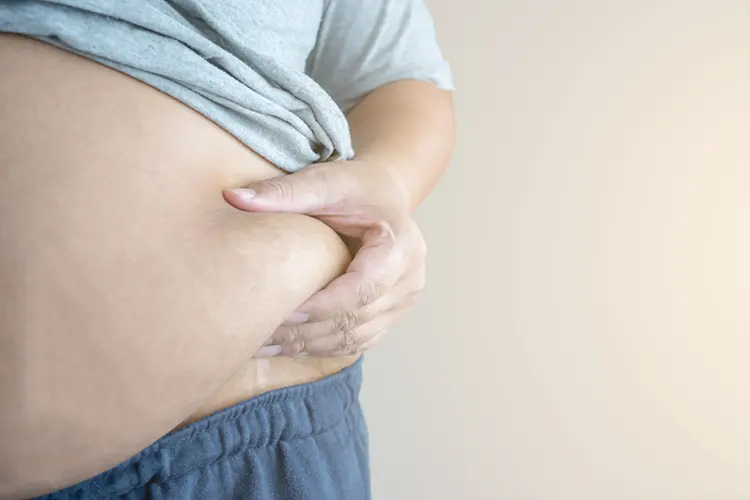
Visceral fat is fat stored deep inside the abdominal cavity, around and between the organs. It is not the fat you can pinch under the skin — that is subcutaneous fat, which is a different type entirely. Visceral fat cannot be seen or felt from the outside, but it is metabolically active in ways that make it one of the most significant health risks associated with ageing. The good news is that it is also one of the most responsive fat types to the right intervention.
What Is Visceral Fat — and Why Is It Different?
Unlike subcutaneous fat — which sits beneath the skin and serves primarily as insulation and energy reserve — visceral fat is embedded within the abdominal cavity, surrounding the liver, pancreas, intestines and other organs. Its location is what makes it dangerous. Visceral fat cells are metabolically active, releasing inflammatory cytokines, free fatty acids and hormones directly into the portal blood supply — the system that feeds the liver. This direct access to the liver means visceral fat contributes to insulin resistance, elevated triglycerides, raised blood pressure and systemic inflammation in a way that subcutaneous fat does not.
A large systematic review published in BMC Public Health found that a higher visceral-to-subcutaneous fat ratio was consistently associated with the development of cardiovascular disease, including hypertension, coronary heart disease and cerebrovascular disease. A separate meta-analysis published in 2023 found that high visceral adiposity was associated with a 55% increased risk of cardiovascular disease and a 45% increased risk of stroke compared to those with the lowest visceral fat levels.
This is why waist circumference matters more than total weight or BMI as a health marker. Two people can have the same BMI but radically different visceral fat levels depending on where their body stores fat. Someone with a normal BMI and a large waist circumference may carry significantly more cardiometabolic risk than someone heavier whose fat is distributed subcutaneously.
How to Measure Your Visceral Fat Level
There are two practical ways to assess visceral fat without a clinical scan.
Waist circumference is the simplest. Measure at the level of the navel, without pulling the tape tight, after breathing out normally. The thresholds used in research and clinical practice:
| Category | Men | Women |
|---|---|---|
| Healthy | Below 94cm | Below 80cm |
| Elevated risk | 94–102cm | 80–88cm |
| High risk | Above 102cm | Above 88cm |
Body composition scanners — the type found in some gyms and pharmacies — provide a visceral fat rating, typically on a scale of 1 to 59. A reading of 1 to 12 is generally considered healthy, 13 to 17 is high, and 18 or above is associated with substantially elevated health risk. These readings are estimates rather than clinical measurements, but they are useful as a tracking tool over time to see whether your approach is working.
Why Visceral Fat Builds After 50
Visceral fat accumulation after 50 is not purely a matter of eating more or moving less — though both factors play a role. The hormonal environment changes in ways that specifically drive fat toward the visceral depot, independent of total calorie intake.
Declining Testosterone in Men
Testosterone in men declines at a rate of roughly 1–2% per year from the mid-30s onward. Testosterone promotes fat oxidation and supports muscle mass — both of which suppress visceral fat accumulation. As levels fall, the body loses a key mechanism for directing energy toward muscle and away from fat storage. The result is a gradual but consistent shift toward increased visceral fat, often without any change in eating habits or activity level.
Oestrogen Decline in Women
The effect in women is more pronounced and faster. Premenopausal women tend to store fat preferentially in the hips and thighs, under the influence of oestrogen. As oestrogen declines during perimenopause and falls sharply at menopause, fat distribution shifts toward the abdominal cavity. Research published in Menopause tracked women longitudinally through the menopausal transition and found that menopause itself — independent of age — was associated with a significant increase in visceral fat and a simultaneous decrease in energy expenditure. A review published in Current Atherosclerosis Reports found that visceral fat increases from roughly 5–8% of total body fat in premenopausal women to 15–20% in the postmenopausal period. For a full breakdown of this, see our guide on menopause belly fat — why it happens and how to shift it. This is a substantial shift driven primarily by hormonal change rather than lifestyle.
Sarcopenia and the Metabolic Slowdown
Muscle mass declines after 50 at roughly 1–2% per year without deliberate resistance training to counter it. Less muscle means a slower resting metabolic rate — fewer calories burned at rest, every hour of every day. The same diet that maintained bodyweight at 40 produces a calorie surplus at 55 not because eating habits have changed but because the body is burning less. This surplus tends to find its way to the visceral depot, particularly in the hormonal environment described above.
Elevated Cortisol
Chronic stress and poor sleep — both common after 50 — chronically elevate cortisol. Cortisol is a storage hormone that specifically promotes visceral fat accumulation. This is not a metaphor — cortisol receptors are more densely expressed in visceral adipose tissue than in subcutaneous fat, making visceral fat particularly responsive to cortisol-driven storage signals. Overtraining, inadequate recovery, chronic work stress and disrupted sleep all feed this mechanism.
The Endomorph Body Type After 50
If you've heard the term endomorph and wondered whether it applies to you, here's the honest picture. The three somatotype classifications — ectomorph (naturally lean), mesomorph (naturally muscular) and endomorph (rounder, prone to fat gain) — are a simplified framework rather than a precise biological system. But the endomorph characteristics are a useful description of what happens to many people's bodies after 50 regardless of how they looked when younger.
The physiological changes described above — declining muscle mass, reduced insulin sensitivity, hormonal shifts — push the body toward endomorph-like characteristics over time. Fat accumulates more easily. Fat loss becomes more difficult. Carbohydrates are handled less efficiently. This is not a fixed genetic fate. It is a set of metabolic changes that respond directly to the right training and nutrition approach. The intervention is the same whether you consider yourself an endomorph or not: resistance training to rebuild muscle, protein prioritisation, and managed carbohydrate intake.
How to Reduce Visceral Fat — What the Research Says
Visceral fat is more metabolically responsive than subcutaneous fat — it releases energy more readily and responds faster to exercise and dietary intervention. A 2023 meta-analysis published in the British Journal of Sports Medicine, covering 65 randomised controlled trials, found that both exercise and caloric restriction significantly reduced visceral fat compared to controls, with caloric restriction producing a larger effect size. Critically, exercise produced meaningful reductions in visceral fat even without significant weight loss — suggesting that the training stimulus itself, independent of calorie deficit, drives visceral fat reduction through hormonal and metabolic mechanisms.
Compound Strength Training
A 2021 network meta-analysis published in the International Journal of Obesity found that HIIT and aerobic exercise of at least moderate intensity were the most effective exercise modalities for reducing visceral adipose tissue. Compound strength training — squats, deadlifts, presses, rows — creates the metabolic demand that drives this response while simultaneously building the muscle mass that raises resting metabolic rate and improves insulin sensitivity. For adults over 50, compound strength training is the non-negotiable foundation of any visceral fat reduction strategy.
Two to three sessions per week is the evidence-based starting point. The exercises that produce the most visceral fat reduction are those that recruit the most muscle mass simultaneously — squats and deadlifts particularly. The beginner's weight training guide covers how to start these safely if you haven't trained before.
High-Intensity Interval Training
HIIT — alternating between periods of high effort and brief recovery — has specific research support for visceral fat reduction beyond what steady-state cardio produces. Two sessions of 20–30 minutes per week alongside strength training is the practical target. This does not mean sprinting until you collapse. Cycling hard for 30 seconds and recovering for 45, repeated for 20 minutes, qualifies. Kettlebell circuits, rowing intervals, or bodyweight circuits all count. The intensity relative to your own capacity is what drives the response, not the modality.
The Nutrition Side
Exercise creates the conditions for visceral fat reduction. Nutrition determines whether it actually happens. The dietary factors most strongly associated with visceral fat accumulation — and therefore most important to address — are:
| Factor | Direction | Mechanism |
|---|---|---|
| Refined carbohydrates | ↑ Visceral fat | Spike blood glucose and insulin; promote fat storage particularly in visceral depot |
| Alcohol | ↑ Visceral fat | Pauses fat oxidation; liver prioritises alcohol metabolism; adds empty calories |
| Chronic stress / poor sleep | ↑ Visceral fat | Elevated cortisol drives preferential visceral storage |
| Dietary protein | ↓ Visceral fat | Preserves muscle mass; stabilises blood sugar; reduces appetite and snacking |
| Omega-3 fatty acids | ↓ Visceral fat | Reduces inflammation; supports insulin sensitivity; improves fat oxidation |
| Meal spacing | ↓ Visceral fat | Allows insulin to fall between meals; creates conditions for stored fat to be accessed |
The full nutritional strategy for visceral fat reduction is covered in detail in the belly fat exercises guide and the nutrition over 50 guide — including the blood sugar management approach and protein targets that make the difference.
Visceral Fat in Women After Menopause
The menopausal transition deserves a dedicated section because the visceral fat response is more rapid and more pronounced in women than the age-related accumulation seen in men. Many women report gaining significant abdominal fat during perimenopause without any change in diet or activity — and this is not perception bias. It is a documented physiological change.
The mechanism is primarily oestrogen-driven. Oestrogen receptors in adipose tissue regulate where fat is stored. As oestrogen declines, the preferential storage in hip and thigh subcutaneous depots reduces, and abdominal visceral storage increases. Energy expenditure also falls at menopause — the longitudinal research found a measurable decrease in total daily energy expenditure independent of activity changes, meaning the body simply burns less at rest after menopause than before.
The practical implication is that the nutritional and training strategy needs to be adjusted — not abandoned. Strength training becomes more important at menopause, not less, because preserving muscle mass is the most effective defence against the metabolic slowdown. Protein targets may need to increase. Carbohydrate tolerance typically decreases. The workouts for women over 50 guide covers the specific training structure, and the section on exercise and menopause goes into the research on how training reduces the severity of menopausal symptoms alongside visceral fat.
A Practical Visceral Fat Reduction Framework
Pulling the research together, the most effective approach for adults over 50 who want to reduce visceral fat:
| Variable | Target | Evidence Base |
|---|---|---|
| Compound strength training | 2–3 sessions/week | Builds muscle; raises RMR; improves insulin sensitivity; directly reduces VAT |
| HIIT / intervals | 1–2 sessions/week, 20–30 min | Network meta-analysis confirms HIIT as most effective exercise modality for VAT reduction |
| Daily walking | 7,000–10,000 steps | Low-intensity movement; cumulative calorie deficit without recovery cost |
| Protein intake | 1.6–2.2g/kg/day | Preserves muscle during fat loss; most satiating macronutrient; stabilises blood sugar |
| Refined carbohydrates | Minimise | Primary dietary driver of visceral fat accumulation via insulin mechanism |
| Sleep | 7–9 hours/night | Sleep deprivation raises cortisol; visceral fat receptors are cortisol-responsive |
| Alcohol | Minimise or eliminate | Directly pauses fat oxidation; promotes visceral storage via cortisol and liver effects |
None of this requires extreme measures. Visceral fat responds relatively quickly to consistent lifestyle change — research suggests meaningful reductions are measurable within 8 to 12 weeks of applying this framework consistently. The key word is consistently, across weeks and months, not intermittently across days.
"Visceral fat is the most metabolically responsive fat in the body. It responds faster to exercise and dietary change than the fat you can see — which is both the problem and the opportunity."
Frequently Asked Questions
Visceral fat is fat stored deep inside the abdominal cavity, surrounding the liver, pancreas, intestines and other organs. Unlike subcutaneous fat — the fat you can pinch under the skin — visceral fat is metabolically active, releasing inflammatory chemicals and fatty acids directly into the portal bloodstream. It is strongly associated with cardiovascular disease, type 2 diabetes and insulin resistance, independent of total body weight.
On body composition scanners, a visceral fat rating of 1 to 12 is generally healthy, 13 to 17 is high, and 18 or above is associated with significantly elevated health risk. Using waist circumference: above 94cm for men and 80cm for women indicates elevated visceral fat. Above 102cm for men and 88cm for women is associated with substantially higher cardiometabolic risk.
No. Visceral fat is located inside the abdominal cavity, between and around the organs — it cannot be felt by pressing on the abdomen. What you can feel under the skin is subcutaneous fat. A firm, protruding belly that doesn't indent easily when pressed is often a sign of significant visceral fat behind the abdominal wall, but visceral fat itself has no tactile sensation.
Visceral fat responds relatively quickly compared to subcutaneous fat. Research shows meaningful reductions can occur within 8 to 12 weeks of consistent compound strength training, HIIT and dietary changes — particularly reduced refined carbohydrates and increased protein. The rate depends on the degree of change applied, but visceral fat is more metabolically responsive than the fat you can see.
Declining oestrogen is the primary driver. Premenopausal women store fat preferentially in hips and thighs under oestrogen's influence. As oestrogen falls at menopause, fat redistribution shifts toward the abdominal visceral depot. Research has found visceral fat can increase from around 5–8% of total body fat in premenopausal women to 15–20% postmenopause. Declining energy expenditure and muscle mass over the same period compounds the effect.
Endomorph describes a body type prone to fat gain, with a rounder, softer physique and difficulty losing fat. After 50, many people find they have shifted toward endomorph characteristics due to declining muscle mass and insulin sensitivity rather than genetics. The approach is the same regardless: compound strength training, protein prioritisation and managed carbohydrate intake.
Unlimited Fitness Ireland
Ireland's fitness resource for the over 50s. We cover strength training, martial arts, motivation and nutrition — because your best training years might still be ahead of you. Age is not a factor.
Related Articles


Sources & Further Reading
Recchia, F., et al. (2023). Dose-response effects of exercise and caloric restriction on visceral adiposity in overweight and obese adults: a systematic review and meta-analysis of randomised controlled trials. British Journal of Sports Medicine. View on PubMed ↗
Chang, Y.H., Yang, H.Y., & Shun, S.C. (2021). Effect of exercise intervention dosage on reducing visceral adipose tissue: a systematic review and network meta-analysis of randomized controlled trials. International Journal of Obesity. View on Nature ↗
Toth, M.J., et al. (2008). Increased visceral fat and decreased energy expenditure during the menopausal transition. International Journal of Obesity. View on PubMed ↗
Emamat, H., et al. (2024). The association between the visceral to subcutaneous abdominal fat ratio and the risk of cardiovascular diseases: a systematic review. BMC Public Health. View on PMC ↗
Muka, T., et al. (2022). Adverse Changes in Body Composition During the Menopausal Transition and Relation to Cardiovascular Risk: A Contemporary Review. Current Atherosclerosis Reports. View on PMC ↗